


Choosing the right Microgreen Trays can affect more than seedling growth. For wholesale buyers, tray design influences packing, storage, cleaning routines, and the daily pace of production. A shallow tray may suit certain crops, while deeper sides can help contain growing media during watering and handling. Drainage holes matter too, but their value depends on the irrigation setup and the grower’s workflow. Small details add up.
This guide explores common tray types for 2026, including solid-bottom, perforated, shallow, and heavy-duty options. It looks at materials, dimensions, stackability, and how well trays fit standard racks or watering systems. Buyers should compare supplier specifications carefully, especially wall thickness, stated material composition, and care instructions. A sample order can reveal weaknesses that a product photo will not. Check before scaling.
Price deserves attention, but the lowest unit cost may not reflect the full expense. A tray that cracks during repeated handling, or takes too long to clean, can disrupt production. Still, durability claims vary, and no single design is best for every crop or facility. No tray wins every time. The recommendations here are intended to help purchasing teams ask practical questions, compare options consistently, and choose trays suited to their own growing conditions. Where food-contact or sanitation requirements apply, confirm relevant specifications with the supplier and qualified local guidance rather than relying on broad product claims.
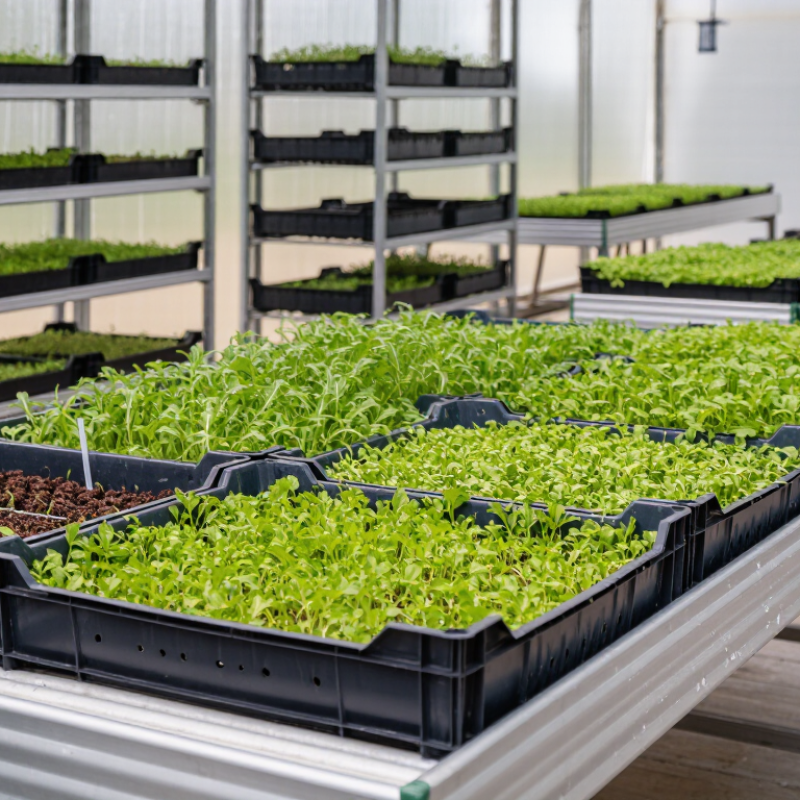
A 1020 tray is a practical reference point for wholesale microgreen production: roughly 10 × 20¾ inches, with small variations between manufacturers. That footprint helps buyers compare rack spacing, seeding density, and transport capacity. Measure the usable inner base, not only the outside rim. A few millimeters can affect how a tray sits on a shelf. Fit matters.
The tray does not determine the harvest schedule. Penn State Extension guidance describes many microgreens as ready within about 7–21 days, depending on crop and growing conditions. That short cycle makes repeatable tray dimensions useful for planning labor and turnover.
Still, one footprint will not suit every operation. Shallow trays may dry faster; deeper sides can complicate airflow and handling.
In a 2012 study in the Journal of Agricultural and Food Chemistry, researchers assessed 25 microgreen varieties and reported vitamin C levels from 20.4 to 147 milligrams per 100 grams of fresh weight. The wide range is a reminder that crop choice matters more than tray size for product characteristics.
For wholesale orders, confirm tray depth, drainage holes, and whether the dimensions match your shelves before committing. A sample run is worth the trouble. I would not assume “1020” means identical capacity everywhere.
For wholesale buyers, tray material affects growing consistency, labor, and shipping costs. Reusable plastic trays are lightweight, stack neatly, and tolerate repeated washing when properly made. Their smooth surfaces are easy to inspect for residue. Thin walls can flex under wet growing media, though, so check loaded trays before ordering pallets. Fit matters too: a tray that catches on shelving slows daily work.
Fiber trays absorb moisture and can support airflow around roots. They may suit short growing cycles, but damp corners can soften during handling. Compostable trays offer a lower-waste option when the material matches the crop cycle and a suitable processing route is available. The word “compostable” alone does not guarantee quick breakdown in every facility. Ask for material details and test a sample through watering, harvest, and transport.
Tips: Compare drainage holes, tray depth, and stack height using your actual media. Run a small trial before committing to bulk quantities. Record cracked corners, warped bases, and cleanup time. I would not judge trays by appearance alone; a sturdy sample can still behave differently after several wet cycles.
For wholesale buyers, drainage design affects crop uniformity, cleanup time, and shipping quality. Solid trays hold water and work well for bottom-watering when growers control fill depth. Too much water can leave a wet layer beneath the mat, encouraging uneven roots and making harvest messier.
Small detail. It matters.
Perforated inserts let excess water pass into a solid catch tray, reducing standing water around stems. They also make watering easier to standardize across racks, though dry edges can appear if irrigation misses the corners.
Grand View Research’s 2024 industry report estimated the global microgreens market at about $2.0 billion in 2023, with an 11.1% projected annual growth rate through 2030. That is a market estimate, not proof that one tray type will outperform another.
For purchasing, compare drainage against crop, substrate, and labor needs. Ask suppliers for tray dimensions, hole spacing, and material thickness, then test both systems with the same seed lot and watering schedule. Record drainage time, mat moisture, and saleable yield.
One caveat: a perforated insert can drain well but still leave water pooled in its catch tray. Check it after irrigation, not just at harvest.
Tray depth should follow the crop’s rooting habit, not a one-size-fits-all purchasing rule. University of Maryland Extension notes that microgreens are commonly harvested about 7–21 days after planting and grown in shallow containers. For fast crops such as radish or broccoli, a shallow tray can reduce media use and simplify handling. Peas and sunflowers usually benefit from deeper media, which gives larger seeds more room to root and helps support heavier stems. Check drainage, too. Waterlogged media can undermine even a well-matched tray.
A practical wholesale range is roughly 1–2 inches of media for many small-seeded crops, with deeper setups for larger seeds and longer growth cycles. Treat that as a starting point, not a universal specification: cultivar, watering routine, and harvest timing all change performance. Xiao and colleagues assessed 25 microgreen varieties in a 2012 Journal of Agricultural and Food Chemistry study, documenting meaningful differences among crops. Their work measured nutrition, not tray depth, so buyers should validate depth with small production trials. A few trays first. Compare root mats, stem stability, and usable yield per shelf. It is easy to overbuy deep trays; I would still test pea and sunflower roots in your actual media before committing.
| Tray Type | Typical Usable Depth | Drainage | Best Crop Fit | Growing Method | Wholesale Buying Considerations |
|---|---|---|---|---|---|
| Shallow solid tray | About 1.5–2 in (3.8–5 cm) | No holes; retains water | Radish, broccoli, cabbage, mustard, and other small-seeded crops | Soil or soilless media; bottom-water carefully or use as the reservoir tray beneath a perforated insert | Useful for standard short-cycle production. Avoid standing water around stems, which can increase disease risk. |
| Shallow perforated tray | About 1.5–2 in (3.8–5 cm) | Drainage holes in the base | Small-seeded brassicas, amaranth, and other crops harvested young | Typically paired with a solid tray for bottom watering; also used with growing media that needs drainage | Check hole size and spacing against the media used. A matching solid tray makes watering and handling easier. |
| Medium-depth solid tray | About 2–2.5 in (5–6.4 cm) | No holes; retains water | Pea shoots, wheatgrass, and larger-seeded crops when grown in media | Soil or soilless media; bottom watering can help keep foliage dry | Provides more media volume than a shallow tray while remaining manageable on many racks. Monitor moisture to prevent waterlogging. |
| Deep solid tray | About 3–4 in (7.6–10 cm) | No holes; retains water | Sunflower and pea shoots, wheatgrass, and crops needing added media depth | Media-based growing; may also serve as a reservoir or catch tray in a paired setup | Greater depth adds weight when filled and uses more media. Confirm rack clearance and safe loaded-tray capacity. |
| Deep perforated tray | About 2.5–3.5 in (6.4–8.9 cm) | Drainage holes in the base | Pea, sunflower, and other larger-seeded crops grown in media | Paired with a solid tray for bottom watering, or used where drainage is required | Useful when deeper media and drainage are both priorities. Verify that the paired tray fits securely and drains evenly. |
| Standard propagation flat with cells | Cell depth commonly about 1.5–2.5 in (3.8–6.4 cm); varies by flat | Often perforated, with a separate catch tray | Usually better for raising individual seedlings than for dense-cut microgreen production | Media-filled cells for transplant production | Consider when the crop will be transplanted rather than harvested as a dense mat. Cell layouts can slow filling and harvesting at scale. |
Depths are practical ranges, not universal standards; tray dimensions and usable depth vary by supplier. Match tray choice to crop, media volume, watering method, rack clearance, and harvest format.
Wholesale tray selection starts with the food-contact file, not the color. Ask suppliers for material identification, intended-use limits, and current compliance documents for the markets you serve. Requirements can vary by location and use, so have your compliance team review the claims. Keep the paperwork with the purchase record. Small detail, big value. Check whether trays are intended for repeated washing, and confirm the recommended temperature and cleaning conditions. A low unit price means little if the tray warps after a few cycles.
Stackability affects freight, storage, and daily handling. Test a full stack, not just one empty tray. Look for stable corners, consistent nesting, and enough separation to prevent trays from locking together when damp. A tray that nests neatly in a catalog photo may jam after washing; that detail is easy to miss. Ask for samples and measure stack height in your own storage area.
Compare cost per usable cycle rather than purchase price alone. Divide the landed tray cost by the number of successful growing and cleaning cycles you can reasonably expect. Include labor, replacement rate, and any extra space needed for storage. For example, a slightly more expensive tray may cost less per cycle if it survives frequent washing and stacks tightly. The estimate will never be perfect. Track damage and replacement over several batches, then revise the calculation before placing a larger order.
Wholesale specifications: food-contact rules, stackability, and cost per cycle
The chart compares nominal growing surface area, calculated from common 10 × 20-inch and 10 × 10-inch tray formats; actual usable area varies by design. Solid and perforated 10 × 20 trays share the same nominal footprint. For wholesale purchasing, confirm food-contact compliance for the specific tray and intended use, test stackability with your workflow, and compare cost per cycle using your purchase price and expected reuse life.