


Why Choose a Smart Circuit Breaker for Your Project?
Choosing the right Smart Circuit Breaker can shape the safety, efficiency, and visibility of an entire electrical project. It is not merely a remote-controlled switch. It is a practical protection device that can detect abnormal current, disconnect a faulty circuit, and report operating data through a connected platform. In a workshop, this may mean identifying an overloaded compressor before its cable insulation becomes dangerously warm. In a residential project, it may mean receiving an alert while nobody is home.
Mike Holt, a respected electrical educator and safety expert, captures the priority clearly: “Protection comes before convenience.” That principle should guide every Smart Circuit Breaker decision. Remote control is useful, but dependable interruption, accurate ratings, and proper coordination with other protective devices matter more. Installation experience also shows that a feature-rich breaker can still fail as a project choice when its communication protocol does not match the building management system.
A Smart Circuit Breaker can offer energy monitoring, overload alerts, fault records, and faster maintenance decisions. These benefits become especially valuable in offices, rental properties, workshops, and small industrial facilities. However, smart functions do not replace sound design. Cable capacity, short-circuit ratings, environmental conditions, and local installation requirements still demand careful review.
The choice is not always obvious. A cheaper conventional breaker may serve a simple circuit well. A connected breaker may create unnecessary complexity in a small project. Good engineering asks a harder question: what information and protection will this installation genuinely need over time? That answer makes the technology useful, rather than fashionable.
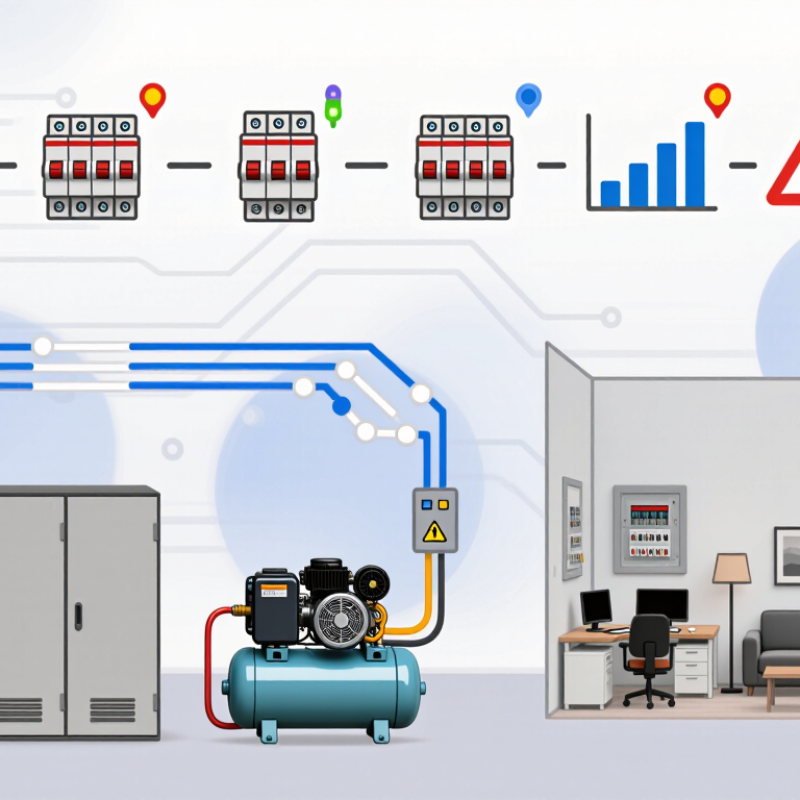
What Is a Smart Circuit Breaker?
What Is a Smart Circuit Breaker?
A smart circuit breaker combines traditional electrical protection with sensors, a control unit, and communication functions. It can detect overloads, short circuits, abnormal temperature, and sometimes leakage current. Unlike a standard breaker, it can report operating data through a local gateway or secure digital network.
This matters as electrical systems become more complex. The International Energy Agency’s Electricity 2024 report projects global electricity demand to grow by about 4% in 2024 and 2025. More connected loads create more opportunities for hidden faults and inefficient consumption. A smart breaker can show current, voltage, power, and trip history. In a project room, an engineer might notice a circuit drawing unusual current before cables become visibly warm.
It is not magic. Protection still depends on correct ratings, wiring, coordination, and installation practice. Applicable requirements, including IEC 60947-2 or IEC 60898-1 where relevant, should guide equipment selection. Remote control also needs strong access management and reliable communication. A disconnected network must not remove basic protection.
The U.S. Department of Energy’s Grid-Interactive Efficient Buildings work highlights the value of sensing, controls, and flexible electrical demand. Smart breakers support this direction by making circuit-level information available. Yet the technology can be oversold. A dashboard may look impressive, while poor calibration produces misleading decisions. For serious projects, measured data, documented testing, and periodic inspection remain more trustworthy than attractive software alone.
Why Choose a Smart Circuit Breaker for Your Project? - What Is a Smart Circuit Breaker?
| Evaluation Criterion | Smart Circuit Breaker | Conventional Circuit Breaker | Project Relevance |
|---|---|---|---|
| Primary function | Protects an electrical circuit from overcurrent and short circuits, with additional monitoring or communication functions depending on the model. | Protects an electrical circuit by automatically interrupting the current during an overcurrent or short-circuit event. | Both provide core electrical protection; a smart model adds visibility and control capabilities. |
| Remote switching | May allow authorized users to switch the circuit on or off through a compatible mobile application, gateway, or automation system. | Normally requires manual operation at the electrical panel. | Useful for remote facilities, rental properties, holiday homes, and equipment that must be isolated without on-site access. |
| Energy monitoring | Some models measure electrical parameters such as current, voltage, power, or accumulated energy. Measurement accuracy and available parameters vary by model. | Typically provides no built-in energy measurement. | Supports energy dashboards, load analysis, consumption tracking, and energy-saving programs when monitoring is included. |
| Overcurrent protection | Uses an integrated protective mechanism with a rated current and trip characteristics specified by the manufacturer. | Uses a thermal-magnetic or electronic trip mechanism with a specified rated current and trip characteristics. | The rated current, breaking capacity, and trip curve must be selected according to the circuit design and applicable electrical standards. |
| Short-circuit protection | Provides short-circuit interruption when the device is correctly rated for the installation and available fault current. | Provides short-circuit interruption when correctly rated for the installation and available fault current. | Check the rated short-circuit breaking capacity before installation; smart connectivity does not replace proper protective sizing. |
| Communication options | May use Wi-Fi, Bluetooth, Zigbee, cellular communication, a wired bus, or another protocol, depending on the product design. | Usually has no digital communication interface. | Protocol selection affects network coverage, cybersecurity, commissioning effort, and compatibility with the project control system. |
| Status notifications | Can provide notifications for events such as trips, power interruptions, abnormal readings, or unauthorized switching when supported by the system. | Status is generally identified locally by the handle position or a visual indicator. | Notifications can reduce inspection time and help maintenance teams respond more quickly to faults. |
| Automation integration | May integrate with building management systems, energy-management platforms, schedules, scenes, or other automation equipment. | Usually operates independently and requires separate accessories for automation. | Suitable for projects that need scheduled load control, demand management, or centralized electrical supervision. |
| Residual-current protection | Available only when the selected device includes residual-current protection or is used with a compatible residual-current device. | Also depends on the specific protective device; a standard overcurrent breaker does not automatically provide residual-current protection. | Do not assume that a smart feature includes earth-leakage protection. Confirm the required protection type separately. |
| Installation requirements | Requires normal protective-device installation plus possible network configuration, commissioning, and cybersecurity settings. | Usually requires electrical installation, testing, and labeling without network commissioning. | Allow additional time for communication setup, user permissions, firmware management, and system testing. |
| Local operation during network failure | Protection functions are generally designed to operate locally, while remote monitoring and control may be unavailable during a communication outage. Confirm this behavior for the selected model. | Continues to provide local manual operation and protective tripping without a data connection. | Projects requiring high availability should verify local fail-safe behavior and define a manual operating procedure. |
| Data and cybersecurity | May collect electrical and operational data and therefore requires secure credentials, access control, updates, and suitable network protection. | Generates little or no digital operating data and has a smaller communication-related attack surface. | Include data ownership, access permissions, network segmentation, and update responsibilities in the project specification. |
| Maintenance visibility | Can provide event logs, operating data, and remote status information when these functions are supported. | Usually requires local inspection and manual measurement for detailed diagnosis. | Smart monitoring can improve preventive maintenance, but electrical testing and physical inspection remain necessary. |
| Initial project cost | Generally higher because of communication hardware, sensors, software, gateways, or commissioning requirements. | Generally lower for basic circuit protection because it has fewer electronic and communication functions. | Compare the additional purchase and installation cost with expected savings from monitoring, reduced site visits, and improved control. |
| Best-fit applications | Smart homes, commercial buildings, distributed facilities, energy-management projects, remote assets, and systems requiring detailed electrical visibility. | Residential and commercial circuits where local protection and manual operation are sufficient. | The appropriate choice depends on required protection, monitoring, automation, budget, network availability, and maintenance strategy. |
Specification note: Actual voltage, current rating, pole configuration, breaking capacity, trip curve, communication protocol, measurement accuracy, enclosure compatibility, and environmental ratings vary by model. Final selection and installation should follow the applicable electrical codes and the manufacturer’s technical documentation.